

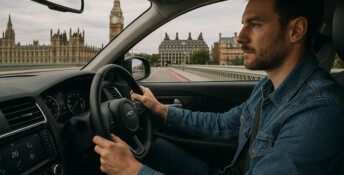
The back of your UK driving licence lists codes that show which vehicles you’re allowed to drive and any specific conditions, like needing to wear glasses or only driving automatics. For example, Category B covers most standard cars, while Category A is for motorcycles.
Understanding these codes is extremely important. Whether you’re renting a car, driving for work, or just want to know your legal limits, be sure to check your licence, and view your driving record – this helps you avoid surprises. Many people realise they have restrictions when stopped by police for driving licence checks or turned away by rental companies.
What are the medical restrictions on a UK driving licence?
Medical restriction codes ensure you meet the medical and legal requirements to drive safely, and possibly, penalty points. If your condition changes, or if you no longer need an adaptation (e.g., after surgery), you must notify the DVLA for your licence to be updated. Here are the five most frequently issued medical-related restrictions you’re likely to see on a UK driving licence:
| Code | Restriction / Requirement | Typical Reason / Use-case |
| 01 | Corrective lenses required – You must wear glasses or contact lenses while driving. | Applied when unaided eyesight does not meet the DVLA’s minimum standards. |
| 78 | Automatic transmission only – You may drive only the categories of vehicles with automatic gearboxes. | Often issued if you passed your test in an automatic car or have a physical disability affecting gear-changing. |
| 44.01 | Adapted steering – Vehicle must have modified steering (e.g., spinner knob, one-handed operation). | For drivers whose physical condition limits standard two-handed steering. |
| 10 | Modified transmission – Vehicle needs a specially adapted gearbox. | Common for drivers with leg-mobility issues who cannot operate a standard transmission. |
| 44.02 | Adapted hand controls – Braking and acceleration handled by hand controls. |
Vehicle adaptations
When we think of driving, we picture our hands on the wheel and our feet on the pedals. But for many UK drivers, independence looks different. There are clever driving adaptations behind licence codes that reinvent car control. These aren’t minor adjustments. From one-handed steering to fingertip controls to pedal adaptations, these systems provide freedom for drivers who would otherwise be excluded. The most common driving adaptations reflect the experiences of thousands of drivers who refuse to let physical challenges stop them. Here are the top three vehicle adaptations that make independence possible.
| Adaptation | Description | Types / Variants |
| Hand Controls | Push-to-brake and pull-to-accelerate systems designed for drivers unable to use foot pedals. | Mechanical and electronic versions |
| Steering Wheel Ball Grips | Enable one-handed steering, available in multiple variations to suit different grip strengths. Allow simultaneous steering and control operation. | Various grip strength variations |
| Left Foot Accelerator | An additional accelerator pedal installed to the left of the brake, intended for drivers unable to use their right foot. | Twin-flip or electronic versions |
What is a tricycle restriction?
A tricycle restriction on a UK driving licence either permits or limits you to driving motor tricycles (three-wheeled motor vehicles), depending on your licence category and personal circumstances. A tricycle restriction on a UK driving licence either permits or limits you to driving motor tricycles (three-wheeled motor vehicles), depending on your licence category and personal circumstances. You can drive a tricycle if:

What general restrictions apply?
Since driving in the United Kingdom is tightly regulated to keep all road users safe, every licence carries general restrictions covering vehicle size, age eligibility, medical fitness and related compliance duties. The top five most common restrictions found on UK driving licences are listed below:
| Code | Description | Details / Conditions |
| 01 | Eyesight correction required | You must wear glasses or contact lenses while driving. |
| 78 | Automatic transmission only | You may only drive vehicles with automatic gearboxes—often applies if you took your driving test in one. |
| 96 | Car + trailer (combined weight 3,500–4,250 kg) | Permits towing beyond standard car-trailer limits but below full BE licence entitlement. |
| 101 | Not for hire or reward | You may drive a minibus, but not for commercial purposes (common with D1 pre-1997). |
| 107 | Vehicle limited to 8,250 kg | Applies to medium goods vehicles under older entitlements (pre-1997), within weight cap. |
Additional aptitude codes
Aptitude codes are special numbers on UK driving licences that indicate whether a driver requires specific equipment or has particular requirements for safe driving.
You can find these codes in column 12 on the back of your driving licence. They are usually two-digit numbers beginning with 4 or 5, and they adhere to European driving standards.
Here are some examples:
| Code | Meaning |
| 40 | Adapted steering |
| 42 | Adapted braking systems |
| 43 | Adapted acceleration systems |
| 44 | General adaptations (requires a sub-code, e.g. 44.01 for modified clutch) |
| 45 | Motorcycle only with sidecar |
| 46 | Tricycles only |
| 50 | Restricted to a specific vehicle (shown on licence) |
| 51 | Restricted to a specific vehicle chassis number |
| 52 | Restricted to a specific registration number |
What are counterpart licence abbreviations?
If you have a paper counterpart to your driving licence, which is still issued mainly in Northern Ireland after being abolished in England, Scotland and Wales in 2015, you will notice short codes called “counterpart licence abbreviations”. These codes spell out the specific restrictions or conditions that apply to your licence. Below are some of the most common abbreviations and their meanings:
| Abbreviation | Description |
| inv. Car. | Limited to invalid carriages |
| nfhr | Not for hire or reward |
| drawbar | Limited to drawbar trailers |
| <8,250kg | Not more than 8,250kg |
| 5.5m | Not more than 5.5m long |
| scc | Under Certificate of Competence |
| Min. age | Under minimum age requirements |




Comment