

The national speed limit in the UK refers to the maximum permissible speed on roads without specific local regulations. On single carriageways, the limit is typically 60 mph for cars, while dual carriageways and motorways allow speeds of up to 70 mph. This limit is reduced to 30 mph in built-up/residential areas. Read the guide below to learn more.
Speed limit for different types of road
Here is a comparison chart for the speed limit according to the type of vehicle and road:
| Type of vehicle | Built up areas | Single carriageways | Dual carriageways | Motorways |
| Cars and motorcycles | England (E) & Scotland (S): 30 mph Wales (W): 20 mph | 60 mph | 70 mph | 70 mph |
| Cars with trailer/caravan | E&S: 30 mph W: 20 mph | 50 mph | 60 mph | 60 mph |
| Motorhomes (up to 3.05 tonnes) | E&S: 30 mph W: 20 mph | 60 mph | 70 mph | 70 mph |
| Motorhomes (over 3.05 tonnes) | E&S: 30 mph W: 20 mph | 50 mph | 60 mph | 70 mph |
| Buses (12 metres or under) | E&S: 30 mph W: 20 mph | 50 mph | 60 mph | 70 mph |
| Buses (over 12 metres high) | E&S: 30 mph W: 20 mph | 50 mph | 60 mph | 60 mph |
| Lorries (up to 7.5 tonnes) | E&S: 30 mph W: 20 mph | 50 mph | 60 mph | 70 mph or 60 mph if articulated or towing a trailer |
| Lorries (over 7.5 tonnes) | E&S: 30 mph W: 20 mph | E&W: 50 mph S: 40 mph | E&W: 60 mph S: 50 mph | 60 mph |
Speed limit for a car towing a trailer on the motorway
As shown above, the speed limit for a car towing a trailer or caravan on the motorway is 60 mph throughout the UK. This is because when a vehicle is towing a trailer, it significantly changes the dynamics of the vehicle’s handling and stability. For example, the stopping distance increases, and the trailer is likely to sway over the lines at high speeds and when turning.
National speed limit signs
Below you will find examples of some of the most common speed limit signs to look out for:

You may see a large red and white circular sign with a number in the middle. This indicates the maximum speed in a specific area. In built up areas, the default speed limit is 30 mph unless there is a sign stating otherwise. In Wales, this limit has been reduced to 20 mph.

Indicates that the previous speed limit is over and the national speed limit for the type of road, area, and vehicle class applies.

Indicates that you are entering a 20mph zone. Local councils usually place these signs in residential areas or areas where there are vulnerable groups of people, such as children.

Found at the start of the motorway to demonstrate that the national motorway speed limit and other regulations apply (unless otherwise stated). Motorway signs are typically blue and white with a white motorway symbol and the number of the motorway.

You will usually see this speed limit sign at the start of a town or village, showing you that you should slow down and pay attention to pedestrians, etc.

Signals the end of roadworks and the end of the related temporary speed limit. Keep an eye out for further notices.

When you see this sign, it means two things:
- speed cameras are in operation in this area, and
- it is the start of a variable speed limit, which you will usually see displayed on electronic signs on the motorways.
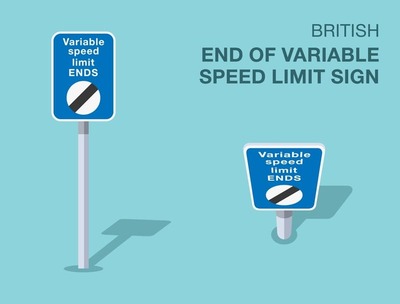
Demonstrates that the variable speed limit has ended and standard speed limits apply.

This blue and white sign actually shows the minimum permissible speed. Driving at lower speeds than this could be dangerous.

Minimum speed is no longer required.
Variable speed limit: what is it?
A variable speed limit refers to a system where the maximum speed allowed on certain roads, particularly motorways, changes depending on traffic conditions, weather, or incidents. These limits are displayed on electronic signs and can be adjusted in real-time to manage congestion, reduce accidents, or improve traffic flow.
Variable speed limits help enhance safety and efficiency by lowering speeds in high-traffic or hazardous conditions while allowing higher speeds when roads are clearer. They are most commonly found on motorways.
Can the speed limit be exceeded?
No. Legally speaking, even if you only drive 1 mile above the speed limit (e.g. 31 mph in built up area) you are breaking the law. The rules are strict because they are critical for protecting pedestrians and road users. While some police officers may follow the ‘10% plus 2’ principle at their discretion, they are not required to.
You should always pay attention to the traffic signs and make sure to decrease and increase your speed in good time based on the limits and road conditions. Make sure to regularly take a glance at the speedometer, which shows the car speed sensor or cable readings.
What happens if I’m caught speeding?
If you’re caught speeding in the UK, you could face several consequences, depending on the severity of the speeding offence:
The minimum penalty for speeding is a £100 fine and 3 penalty points added to your licence. In cases of minor offences, you may be given the option to take a speed awareness course to avoid other penalties but you will have to pay for the course yourself.
The greater the offence, the higher the fine and penalty points will be. For more serious cases, you might be summoned to court, where you could face a larger fine, more points, or even a total driving ban.
If you are a new driver and passed your driving test less than 2 years ago, your driving licence will be revoked if you accumulate 6 or more penalty points.
Can I lose my license for speeding?
Yes, in the UK, you can lose your driving license for speeding, particularly if you accumulate too many penalty points. If you receive 12 or more penalty points within a 3 year period, your license may be revoked or suspended.
Additionally, for serious cases (i.e. excessively high speeds), you may be taken to court and face a larger fine, more penalty points, or even a driving ban. New drivers who accumulate 6 or more penalty points within two years of passing their test can also have their license revoked.
Minimum speed limit?
In the UK, there is no national minimum speed limit for all motorways and high-speed roads. However, in some areas, a minimum limit may be in force to ensure traffic flows smoothly and prevent vehicles from moving too slowly, which could cause congestion or increase the risk of accidents. These speed requirements are typically indicated by blue and white circular road signs.
It is illegal to drive so slowly that you obstruct the flow of traffic and provoke other road users to take risks and overtake you dangerously. This is particularly dangerous on motorways and dual carriageways.
Is a car’s speedometer accurate?
As a rule, your car speedometer will show mostly accurate readings, but they are never 100% accurate. This is in part due to the fact that most speedometers measure speed based on the rotation of the wheels, not considering changes in the tyre size, tyre pressure, and the vehicle’s load. All of these factors can lead to slight inaccuracies.
Due to this, speedometers are calibrated slightly higher to ensure that drivers don’t unknowingly drive over the limit. The margin of error is often within 1-5% of the car’s true speed. If you notice that the readings are erratic or the speedometer is not working at all, it will need to be repaired ASAP to prevent accidents and fines. It may need recalibrating or a new car speedometer cable or sensor.
Top products related to this topic:



Comment